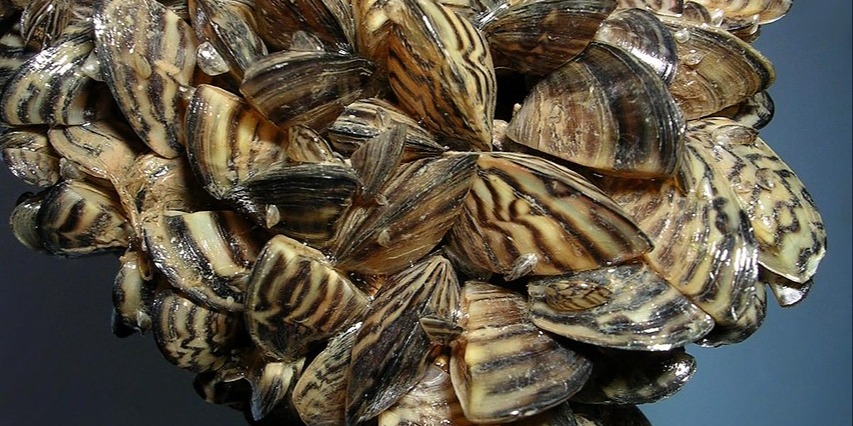
Zebra Mussels
Small shells with a big impact
What are they?
Small freshwater mussels originally from Eurasia that attach themselves to hard surfaces.
Why are they invasive?
They reproduce rapidly, compete with native mussels for food and can coat rocks, docks, boat hulls and other surfaces. Their filtering also changes how nutrients and food move through the lake ecosystem.
How to spot them
-
Small, typically under 3 cm.
-
Hard, triangular or D-shaped shells.
-
Alternating light and dark stripes are common.
-
Often found in dense clusters attached to rocks, docks, ropes, boat hulls or other mussels.
They can be mistaken for other small mussels, so photograph suspected specimens for confirmation.
If you find them:
-
Photograph the shells where you found them.
-
Record whether they're on a dock, rock, boat or other surface.
-
Report a suspected new occurrence.
-
Don't scrape or wash them into the lake, and don't move attached material to another waterbody.
-
Inspect boats, trailers, paddles, anchors and dock equipment before moving them elsewhere.
Never move live mussels to another lake. Don't assume that because a boat or dock is already in the water, attached mussels are harmless.