Case study: Minneapolis shootings
When 3,000 federal immigration agents descended upon Minneapolis for "Operation Metro Surge," chaos ensued. Renee Good, a 37-year-old mother of three, was slain by an Immigration and Customs enforcement (ICE) agent on January 7, 2026. When the news first came out, limited information was available. In order to provide accurate updates and get to the bottom of the story, journalists scoured social media footage for clues. Some of the most revealing content was obtained by local newspaper, the Minnesota Star Tribune.
Investigation into Renee Good's death by the Minnesota Star Tribune
Jasmine Perry, an open source journalist at Storyful, said the earliest information she received about the shooting of Good came from a post on X: "Witnesses say that a woman was SHOT in the face while possibly trying to flee ICE in Central Minneapolis."
"There were no official statements to corroborate this. We really just had this one tweet from a person on the ground saying there might be a story, but that's not enough."
Jasmine Perry, Open source journalist, Storyful
Shortly after seeing the post, Perry started looking for official statements to corroborate the shooting. Twenty minutes after the original post, the city of Minneapolis revealed the alleged location of the incident on its X account. "Getting that one official statement was going to help us find other videos, because we now had a specific location to look at," Perry said.
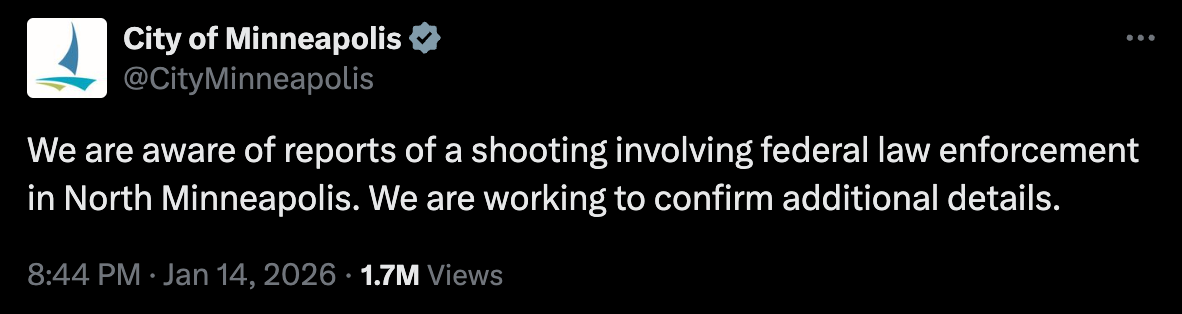
Perry warned that skepticism was crucial at this moment. It emerged that Good was in fact killed in South Minneapolis, not in the North, as the city initially claimed.
"You want to find as many different points of information, like tweets, videos and reports, that can build on each other and help you paint the bigger picture. If we were just basing our work off of official statements, what we shared would have been wrong."
Perry scraped social media for more information. She searched for other posts, images and videos using keywords like: "protest," "shots," "gun fire," "ICE" and more (see Chapter 5 on Dorking). She further filtered her searches by searching for posts after a certain date and time with specific geographic tags. She didn't use just one social media, she scraped TikTok, Instagram, Facebook and Twitter.
"I feel like a lot of social news gathering is just becoming really good at writing different iterations of words, but that is kind of how it works. You want to try to build the most effective search possible, and that means looking as widely as possible," Perry said.
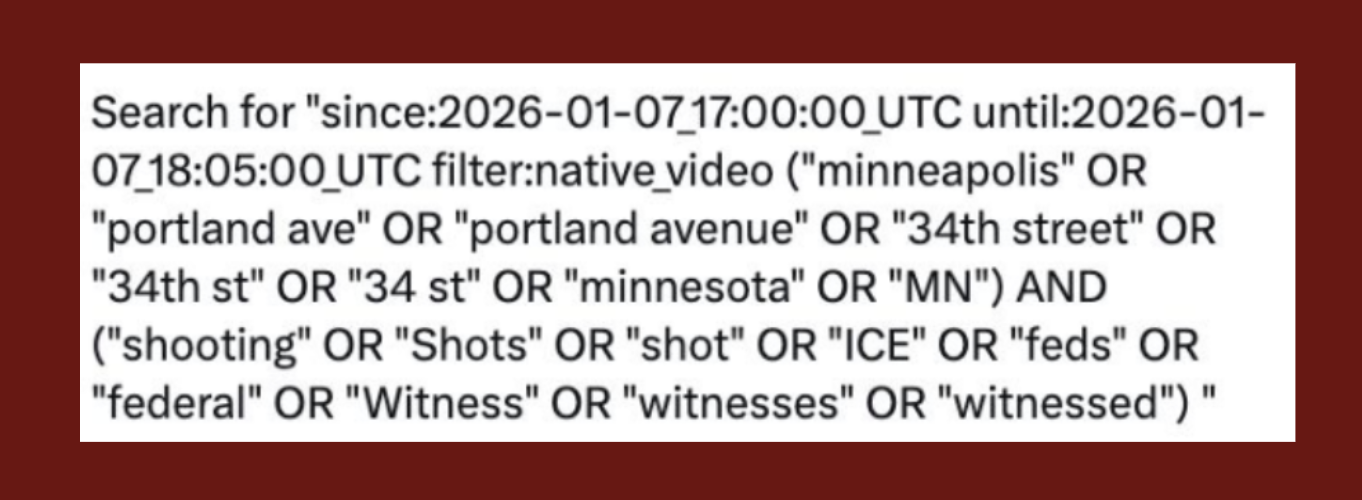
Search terms Perry used to find videos related to the shooting of Renee Good
Once Perry was able to find videos, she reached out to the people who posted them in search of the original source. She was able to get in contact with a journalist who was on the scene and had filmed a video. After piecing together more of the puzzle, Perry was able to continue her search and find more original video from the scene.
Perry explained that only through constantly searching and re-searching was she able to find more information connected to the shooting.
"One of the biggest tips that I can give for news gathering is you really do constantly have to be refreshing and researching all the time. It's not like Facebook and X are going to refresh their pages whenever you're on it. It's on you to do that due diligence," said Perry.
Shortly after Good was killed, Alex Pretti, a 37-year-old ICU nurse, was shot on January 24, 2026 by two federal immigration agents. In both cases, open source journalism was able to challenge the White House narrative that they were "domestic terrorists."