Fire & Combustion
What is fire?
The term "fire" refers to how something burns.
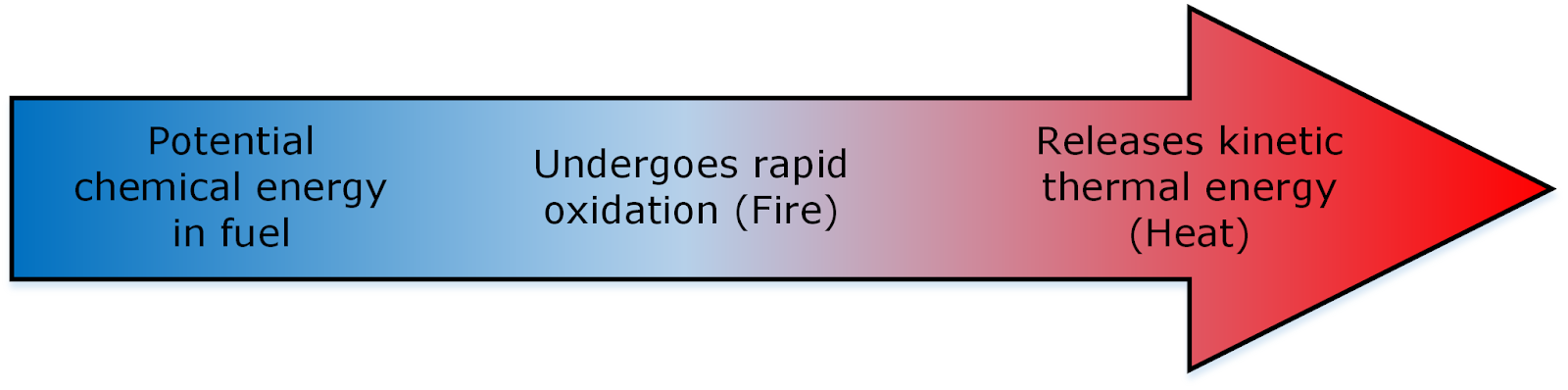
Fire: A rapid oxidation process, which is a chemical reaction resulting in the evolution of light and heat in varying intensities.
The structure of the fire will change depending on how the process of combustion takes place.
Combustion is a chemical process of oxidation that occurs at a rate fast enough to produce heat and usually light in the form of either a glow or flame.
Endothermic and Exothermic Reactions
Chemical reactions can be divided into two main categories depending on whether they absorb or release energy as they occur.
Endothermic: a reaction that absorbs heat energy.
Exothermic: a reaction that releases heat energy.
Energy, Work and Power
The concepts of heat as energy, of temperature and of heat release rate are very important concepts to understand when discussing fire behaviour. Knowledge of the differences between these terms is particularly critical when assessing the 'heat' that is being generated in a fire and understanding how it transfers to the surrounding environment.
Energy: The capacity to do work.
Work: The transfer of energy from one place to another, or from one form to another.
Power: The rate of doing work, or how fast work is done.
Think about it this way…
Imagine there are two cars of the same weight at the bottom of a large hill. The energy that will be used to drive the cars up the hill will come from the gasoline; moving the cars to the top of the hill will be the work; and how quickly the cars make it to the top of the hill will be the power.
If two identical cars were driven up a hill, one in 60 seconds and the other in 30 seconds, both would have done the same amount of work; however, the car that drove up the hill in 30 seconds would have required twice the power.
It is sometimes easier to understand energy by considering the many forms of energy that exist, including:
- Chemical
- Thermal
- Mechanical
- Electric
- Magnetic
- Nuclear
Energy can be then further categorized into two broader categories; kinetic and potential energy.
|
Kinetic Energy: The energy of motion. |
|
Potential Energy: The stored energy of an object. |
Figure 1: Potential to kinetic energy conversion
Units of Energy
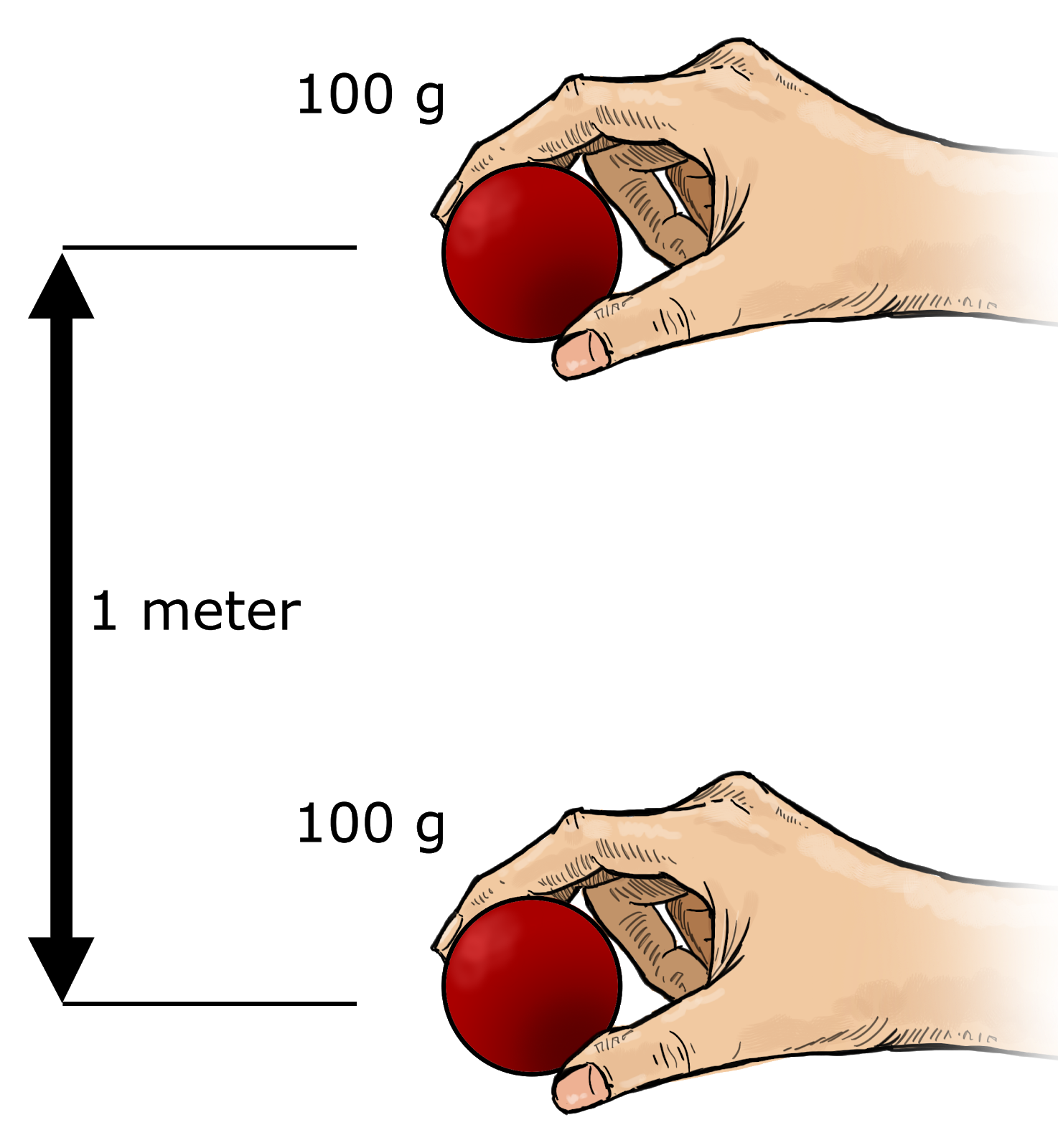
As discussed previously, work is done when a force is applied on an object to push or pull it through some distance. For work to be done, the object's energy must change. In Figure 2, when the object is moved from a higher to a lower position, work is done and the potential energy in the object is changed (because of the change in height from a reference point).