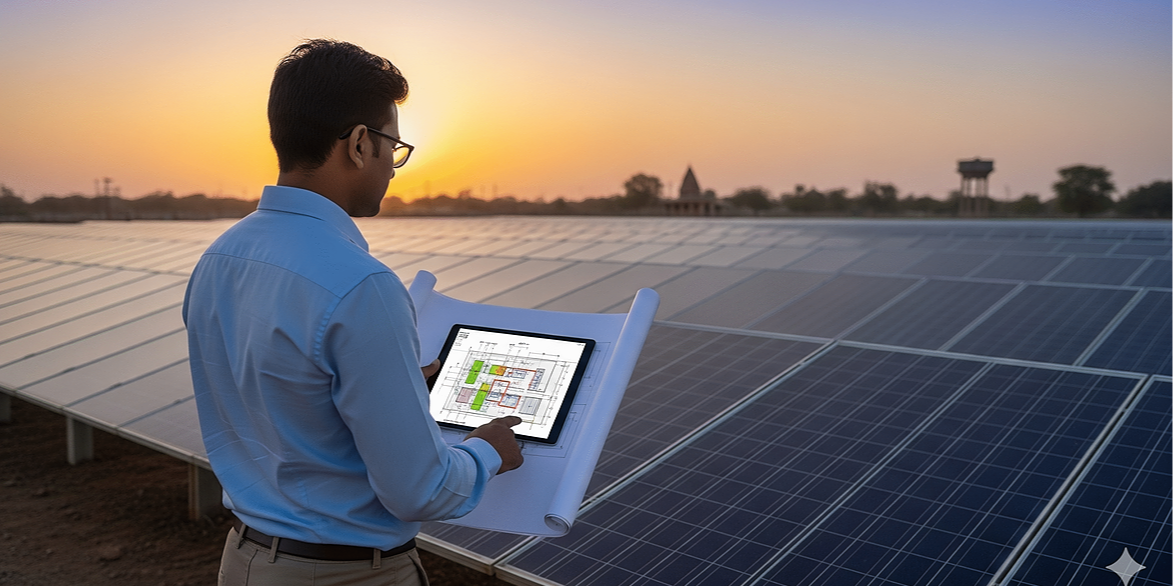
Utility Scale Solar EPC Developers India: Market Insights, Technology Trends & Best Companies (2025 Guide)
India's renewable energy landscape is entering its most aggressive expansion phase. As the demand for clean and reliable power grows, utility scale solar EPC developers in India are driving the country's transformation toward large, grid-connected solar power generation. These developers build massive solar farms that supply power directly to state utilities, industries, and large corporate buyers through long-term PPAs.
Utility-scale plants are no longer just energy projects; they are now financial assets, sustainability milestones, and national infrastructure. With India targeting 300 GW of solar capacity by 2030, the role of experienced EPC contractors has never been more important.
This guide breaks down the Indian EPC ecosystem, leading developers, construction process, cost estimates, and the latest advancements shaping the future of large-scale solar.
Table of Contents- Understanding Utility-Scale Solar EPC Development
- India's Demand for Utility-Scale Solar Projects
- Core Responsibilities of EPC Developers
- Top Utility Scale Solar EPC Developers in India
- Complete Project Development Cycle
- Cost of Building a Utility-Scale Solar Plant (2025 Costs)
- Latest Technologies in Utility-Scale Solar
- Key Risks & Mitigation Strategies
- How to Choose the Right Solar EPC Developer
- FAQs
- Conclusion

Utility-scale
solar refers to solar farms that generate large amounts of
electricity-usually above 10 MW-and feed it directly into the grid.
These projects play a crucial role in India's long-term transition to
renewable energy.
What EPC Means in Solar
EPC stands for:
- Engineering: System design, module layout, structure analysis
- Procurement: Sourcing components like modules, inverters, transformers
- Construction: Installation, civil work, commissioning
After completion, many developers also offer long-term O&M services to maintain plant performance for 25 years.
Why EPC Developers Matter
Reliable utility scale solar EPC developers India ensure:
- Optimized project cost
- High energy yield
- Faster construction timelines
- Better grid stability
- Long-term reliability
Since utility-scale plants require significant investment, experienced EPC companies reduce financial and operational risks.
India's Demand for Utility-Scale Solar ProjectsIndia is expanding its renewable energy sector at unprecedented speed. The country aims to become a global hub for utility-scale solar due to its climate, land availability, and government support.
Key Drivers Behind Growth
1. Lower Solar Power Tariffs
Utility-scale solar has reduced India's power costs, offering tariffs as low as INR 2.20-2.90 per unit.
2. Government Incentives
Policies like ISTS waiver, ALMM subsidies, PM-KUSUM, and tender-based bidding drive large-scale adoption.
3. Increasing Corporate PPA Demand
Industries want clean power to meet their sustainability goals.
4. Energy Security Needs
Solar reduces dependence on imported coal and fossil fuels.
States Leading in Utility-Scale Solar
- Rajasthan
- Gujarat
- Karnataka
- Andhra Pradesh
- Tamil Nadu
These states offer strong irradiation and easier land availability, making them a preferred location for EPC developers.
Core Responsibilities of EPC DevelopersA full-service EPC provider handles the complete lifecycle of a utility-scale project.
1. Pre-Engineering & Site Assessment
Includes:
- Land survey
- Topography study
- Irradiance measurements
- Soil testing
- Shading analysis
2. Project Design & Engineering
Developers prepare:
- Single line diagrams
- Structural layouts
- AC/DC design
- Energy yield reports
- Cable routing plans
3. Procurement of Equipment
EPC developers negotiate with leading suppliers for:
- Mono/bifacial modules
- Central/String inverters
- MMS structures
- HV equipment
- Transformers
- Switchgear
- Cables & connectors
Reliable procurement ensures lower downtime and high generation.
4. Construction & Execution
Includes:
- Earthwork and civil foundations
- Structure assembly
- Module mounting
- Cable trenching
- Substation installation
- Transmission line work
5. Testing & Synchronization
Developers ensure compliance with:
- Grid codes
- Safety standards
- Load flow testing
6. Operation & Maintenance
O&M includes:
- Module cleaning
- Vegetation control
- Thermal scanning
- Fault monitoring
- Inverter maintenance
This guarantees 25-year performance stability.
Top Utility Scale Solar EPC Developers in India (2025 Edition)Here are the leading companies shaping India's utility-scale solar market.
1. Tata Power Solar
- Strong presence in government and corporate solar tenders
- Proven reliability in desert and coastal climates
2. Adani Solar
- World's largest integrated solar manufacturer
- Dominates large utility-scale installations
3. Sterling & Wilson Renewable Energy
- International EPC experience in 25+ countries
- Known for megawatt-scale engineering expertise
4. Mahindra Susten
- Data-driven project design
- Strong focus on O&M, remote monitoring
5. L&T Green Energy
- Heavy engineering capability
- Strong in electrical and grid infrastructure
6. ReNew Power
- Leading independent power producer
- Strong in hybrid and storage-based utility projects
H3: 7. Avaada Energy
- Rapid expansion across India
- Focus on high-efficiency project execution
These companies ensure reliable execution of projects ranging from 50 MW to 1 GW and above.
Complete Project Development CycleA utility-scale project follows a systematic approach that ensures quality and timely delivery.
Step 1: Concept & Feasibility
- Project feasibility study
- Solar resource assessment
- Land identification
- CAPEX/OPEX estimation
Step 2: Land Acquisition
EPC developers work with:
- Local authorities
- Land aggregators
- Solar park developers
Step 3: Approvals & Permits
Includes:
- State nodal agency approval
- Grid connectivity clearance
- Environmental NOC
- Land conversion approvals
- CEIG permissions
Step 4: Financial Closure
Projects often involve:
- Equity
- Debt
- Government subsidies
Step 5: Procurement & Delivery
Modules, inverters, transformers, and structures are delivered to the site via optimized logistics.
Step 6: Construction & Installation
- Civil foundations
- MMS erection
- Module installation
- Cable and trench work
Step 7: Testing & Commissioning
Developers ensure:
- SCADA integration
- Substation readiness
- Relay protection testing
Step 8: Performance Optimization
Post-commissioning includes:
- I-V curve testing
- Thermography
- PR assessment
The average cost of utility-scale solar in India ranges from INR 3.1 crore to INR 4.2 crore per MW.
Cost Breakdown (Approximation)
| Component | Cost Share |
|---|---|
| Solar Modules | 48-52% |
| Inverters | 12-16% |
| Structures | 10-14% |
| Civil Work | 8-12% |
| Transmission & Evacuation | 5-7% |
| BOS & Cabling | 6-8% |
| EPC Margin | 3-5% |
Factors Affecting Cost
- Module technology (bifacial vs mono)
- Land conditions
- Distance to substation
- Labor rates
- Site development cost
- Evacuation charges
Technology is transforming large solar farms into highly efficient and low-maintenance power plants.
1. Bifacial Modules
Generate power from both sides, increasing output by 8-12%.
2. Single-Axis Trackers
Track the sun's movement to boost energy yield by up to 20%.
3. Robotic Cleaning Systems
Reduce water consumption and improve module performance.
4. Smart Inverters
Provide better grid stability and voltage control.
5. SCADA with AI
Allows predictive maintenance and real-time monitoring.
6. Energy Storage Integration
Battery systems help utilities manage peak load demand.
Key Risks & Mitigation StrategiesRisk 1: Land & Approvals Delays
Solution:
Choose EPC developers with experience in land acquisition and state-level clearance.
Risk 2: Module Price Volatility
Solution:
Long-term procurement contracts reduce cost fluctuations.
Risk 3: Transmission Constraints
Solution:
Early coordination with state load dispatch centers and DISCOMs.
Risk 4: Environmental Impact
Solution:
Low-impact construction and vegetation-friendly design.
Risk 5: O&M Issues
Solution:
Automated monitoring, robotic cleaning, and predictive maintenance.
1. Evaluate Experience
Prefer developers with proven projects above 100 MW.
2. Assess Financial Stability
Utility-scale projects require strong financial capability.
3. Check Technology Partnerships
Ensure they use Tier-1 module and inverter brands.
4. Compare Performance Warranties
Higher PR guarantees mean better long-term output.
5. Review O&M Capabilities
Look for:
- AI-based monitoring
- On-site teams
- Spare parts availability
6. Visit Past Projects
This helps verify build quality and operational performance.
FAQs1. What is the meaning of utility-scale solar?
It refers to large solar farms above 10 MW that supply power directly to the grid.
2. Who are the top solar EPC developers in India?
Tata Power Solar, Adani Solar, Sterling & Wilson, Mahindra Susten, L&T, Avaada, and ReNew Power.
3. What is the cost per MW of utility-scale solar in India?
Around INR 3.1 to 4.2 crore per MW depending on technology and location.
4. How long does it take to build a utility-scale project?
A 100 MW project usually takes 6-10 months.
5. Which modules are best for large solar plants?
Bifacial modules with single-axis trackers are preferred for high yield.
ConclusionIndia's large-scale solar industry is expanding at a remarkable pace. With ambitious national targets, policy support, and increasing corporate adoption, utility scale solar EPC developers India are shaping the future of the country's energy ecosystem. From engineering excellence and project financing to advanced technologies and long-term O&M, these developers ensure high-quality and cost-efficient execution of megawatt-scale solar projects.
As solar becomes central to India's energy mix, choosing the right EPC partner will determine long-term plant performance, investment stability, and energy output. Whether you are an investor, IPP, or industry stakeholder, this guide gives you the clarity needed to navigate the evolving solar EPC landscape.