Changes Coming for Eligibility & Training Requirements
The eligibility and training requirements for membership in the HPCN HVAC sector are changing to integrate the new BCIT Residential Air to Air Heat Pump Specialist Microcredential. These changes reflect the evolving needs of industry and emerging best practices training.
Please read the following FAQs carefully for more information.
You can also watch a recording of a webinar we hosted on March 11 where we discussed the changes and answered questions live. Watch the recording here.
LIST OF QUESTIONS (SCROLL DOWN TO READ & ANSWERS)
- What is changing?
- Who will be affected by these changes?
- When will the changes take effect for new registrants (i.e. what are the "effective dates" mentioned in question #1)?
- When will the changes take effect for existing HPCN members (i.e. what are the "effective dates" mentioned in question #1)?
- Can our installer(s) complete the new training requirements before the effective date(s)?
- How do I sign-up for the new training courses?
- Will training subsidies still be available for the new training requirements?
- Will my existing training count towards the new training requirements?
- Does the training need to be taken in a certain order?
- Why are the training requirements changing?
- What happens if my company becomes an HPCN member right before the effective date for existing members?
- What happens if we don't complete the new training requirements by the effective date(s)?
- What happens if we do not have an eligible installer to complete the new training requirements?
- How will these changes affect Red Seal Refrigeration and Air Conditioning Mechanics (RACMs)?
- How will these changes affect furnace installers?
- Are there any exceptions to the required training or permitted substitutions?
- As an existing HPCN member, I/my employee is completing the Quality Installation of Forced Air Furnace and Air Source Heat Pump Retrofits in BC Homes course (within the 6-month post-membership deadline). Should I/they continue the course?
- Why is the Red Seal Refrigeration and Air Conditioning Mechanic trade designation not a mandatory qualification for HPCN HVAC contractors? Why are other trades allowed to join the HPCN?
QUESTIONS AND ANSWERS
1. What is changing?
Eligibility and training requirements for HVAC sector membership in the Home Performance Contractor Network (HPCN) are changing to integrate the new BCIT Residential Air to Air Heat Pump Specialist Microcredential.
Eligibility
As of the effective dates shared below, companies wishing to join, or remain members of the HPCN HVAC sector, will need to employ installers who meet one of the following eligibility criteria AND have completed the new HPCN training requirements:
- A journeyperson Red Seal Refrigeration and Air Conditioning Mechanic (RACM).
- An Eligible Trade, defined as a journeyperson or final-level apprentice in Plumbing, Pipefitting/Steamfitting, Gasfitting, or Sheetmetal trades. A final-level apprentice Red Seal Refrigeration and Air Conditioning Mechanic is also included in this group.
Companies who do not have installers meeting one of the eligibility criteria above will no longer be eligible for membership in the HPCN as of the effective dates below.
With the addition of these new eligibility requirements, companies no longer need to be operating in BC for a minimum of three years.
Companies will be eligible to join the HPCN if installers complete the required training requirements AND the company meets all other registration criteria.
Training
The new training requirements integrate the new BCIT Residential Air to Air Heat Pump Specialist Microcredential and will be as follows. Be sure to note the exception of the hands-on course for specific individuals.
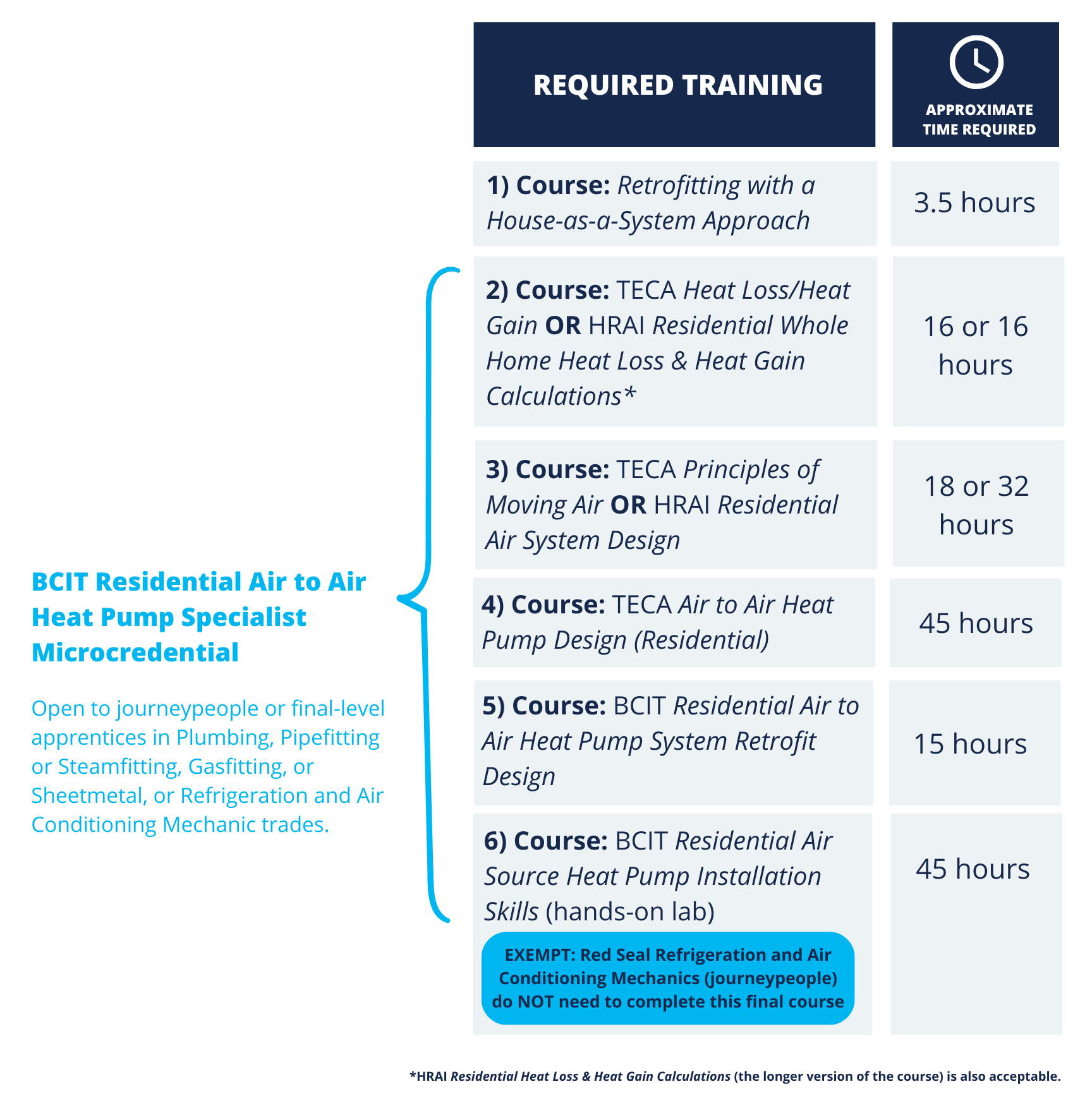
Summary of Training Changes
With the integration of the new BCIT microcredential, the HPCN training requirements are moving from 67.5 hours to 142.5 hours and include a new hands-on lab course for Eligible Trades. For Red Seal Refrigeration and Air Conditioning Mechanics, the training requirements are moving to 97.5 hours as they are exempt from the hands-on course.
2. Who will be affected by these changes?
Both HVAC companies that wish to become a member and existing members of the Home Performance Contractor Network (HPCN) will be affected.
Note: If your company does not directly employ HVAC installers but you subcontract out the work you do not need to become a member of the HPCN, instead your subcontractor should become a member. Learn more about subcontractors in the HPCN on the general FAQs page.
The HPCN is a voluntary initiative with benefits that include:
- Enabling your customers access to select rebates from our program partners including CleanBC, BC Hydro, FortisBC, and Pacific Northern Gas.
- Training subsidies to cover the cost of training plus a wage contribution (while funding lasts).
- Business information displayed in the HPCN and CleanBC Better Homes search tools, which is promoted across BC.
- Public recognition for quality work and the use of the Home Performance Contractor Network logo.
- Invitations to exclusive networking, engagement, and training opportunities for home performance professionals and stakeholders.
You DO NOT need to complete the new training requirements to legally complete HVAC work in British Columbia. The training is only required for membership in the HPCN to enjoy benefits such as offering your customers rebate access.
3. When will the changes take effect for new registrants (i.e. what are the "effective dates" mentioned in question #1)?
New registrants are defined as
- companies wishing to join or rejoin the Home Performance Contractor Network (HPCN)
- employees completing the training (for the first time) for existing HPCN member companies
The table below outlines the effective date for the new training requirements. Pay close attention to dates as they vary based on your service territory and existing credentials.
| NEW REGISTRANTS | Eligible Trade* | Red Seal RACM** | Non-Eligible Trade and Non-RACM |
| Lower Mainland | September 1, 2026 | September 1, 2026 | Not eligible to join the HPCN as of September 1, 2026 |
| Other regions of BC | TBC To be confirmed as the hands-on course becomes available in other areas of BC. We are aiming to provide one year's notice from the first date of availability to the requirement taking effect. More information will be provided as it is available. |
September 1, 2026 | Not eligible to join the HPCN as of September 1, 2026 |
*Eligible trades are journeypeople or final-level apprentices in Plumbing, Pipefitting/Steamfitting, Gasfitting, or Sheetmetal trades. Final-level apprentice Red Seal Refrigeration and Air Conditioning Mechanics are also included in this group.
** Journeypeople Red Seal Refrigeration and Air Conditioning Mechanics.
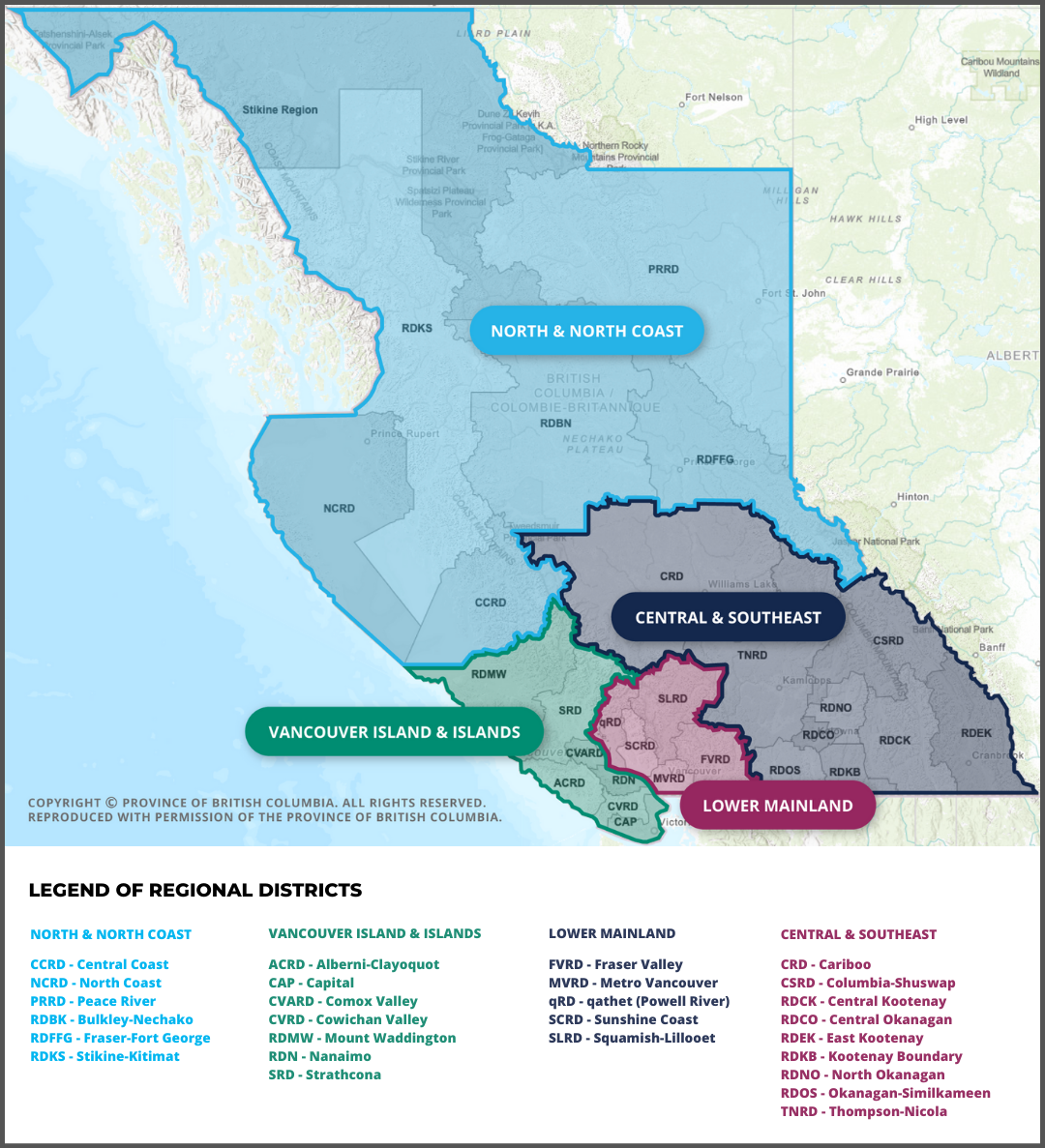
The HPSC defines the Lower Mainland and other areas of BC according to the map and legend below. Companies will be subject to the "effective date" based on their service territory, not their physical office location.
4. When will the changes take effect for existing HPCN members (i.e. what are the "effective dates" mentioned in question #1)?
Existing members are defined as
- companies that are already members of the Home Performance Contractor Network (HPCN) prior to the effective date(s)
- employees (of an HPCN member company) that have completed the previously required HPCN training
The table below outlines the "effective date" for the new training requirements. Pay close attention to dates as they vary based on depending on your service territory and existing credentials.
| EXISTING MEMBERS | Eligible Trade* | Red Seal RACM** | Non-Eligible Trade and Non-RACM |
| Lower Mainland | September 1, 2027 | September 1, 2027 | No longer eligible for membership in the HPCN as of September 1, 2027 |
| Other regions of BC | TBC To be confirmed as the hands-on course becomes available in other areas of BC. We are aiming to provide one and a half year's notice from the first date of availability to the requirement taking effect. More information will be provided as it is available. |
September 1, 2027 | No longer eligible for membership in the HPCN as of September 1, 2027 |
*Eligible trades are journeypeople or final-level apprentices in Plumbing, Pipefitting/Steamfitting, Gasfitting, or Sheetmetal trades. Final-level apprentice Red Seal Refrigeration and Air Conditioning Mechanics are also included in this group.
** Journeypeople Red Seal Refrigeration and Air Conditioning Mechanics.
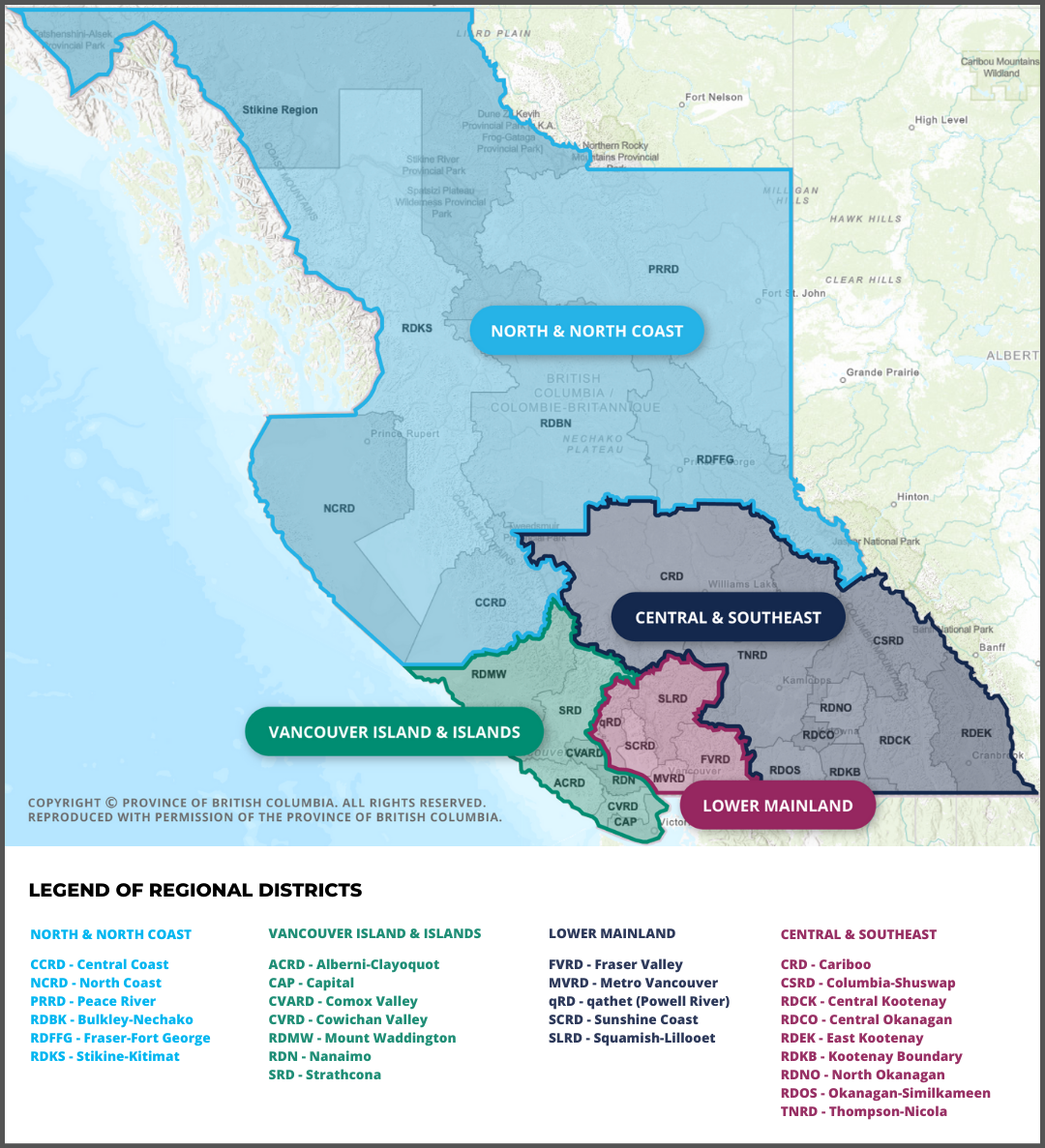
The HPSC defines the Lower Mainland and other areas of BC according to the map and legend below. Companies will be subject to the "effective date" based on their service territory, not their physical office location.
5. Can our installer(s) complete the new training requirements before the effective date(s)?
Yes, effective immediately the new training requirements are the recommended and preferred option for joining the HPCN HVAC sector. Installers may complete the new requirements at any time now to be considered a qualified HPCN installer.
The effective date(s) above are when the new training requirements become mandatory for the HPCN.
6. How do I sign-up for the new training courses?
Some of the training courses are available directly through BCIT while others are available through the HPSC, TECA, or HRAI. The table below explains the registration options. You can register for the BCIT microcredential right away or complete the first few courses and then register with BCIT.
| Course | Registration Instructions |
| Online: HPSC Retrofitting with a House-as-a-System Approach | No changes. Available in the HPCN Portal. |
| Online: TECA Heat Loss/Heat Gain OR HRAI Residential Whole Home Heat Loss & Heat Gain Calculations* *HRAI Residential Heat Loss & Heat Gain Calculations (the longer version of the course) is also acceptable. |
Choose one option:
|
| Online: TECA Principles of Moving Air OR HRAI Residential Air System Design |
Choose one option: Register online with TECA Register online with HRAI Contact BCIT to register at soce-heatpump-microcredential@bcit.ca or 604-432-8697 |
| Online: TECA Air to Air Heat Pump Design (Residential) | Choose one option:
|
| Online: BCIT Residential Air to Air Heat Pump System Retrofit Design | Contact BCIT to register at soce-heatpump-microcredential@bcit.ca or 604-432-8697 |
| In-Person: BCIT Residential Air Source Heat Pump Installation Skills (hands-on lab) | Contact BCIT to register at soce-heatpump-microcredential@bcit.ca or 604-432-8697 |
7. Will training subsidies still be available for the new training requirements?
Yes! As always, training subsidies will be available for 100% of course costs plus a wage contribution while funding lasts. Companies pay for their installers' training upfront and submit a request for reimbursement after becoming full HPCN members.
Subsidies are even available for journeypeople RACMs who wish to take the hands-on lab course, which is an optional course for them.
Other discounts or grants may be available through BCIT. In those cases, HPCN members are eligible for reimbursement of up to 100% of the course costs after these other discounts or grants were applied.
8. Will my existing training count towards the new training requirements?
Yes! You do not need to re-take any of the required training that you have already completed.
Everyone will need to register with BCIT to complete the microcredential. When registering, simply inform BCIT of any prior training you have completed.
Existing Members' Training
Some existing HPCN members have already completed three of the six (3/6) required courses, while others have completed two of the six (2/6) required courses, as there is overlap between the original and new training requirements.
The following table provides a breakdown of how the original training pathway translates to the new training pathway for existing HPCN members.
| Original Training Pathway | New Training Pathway | Action Required for Existing Members |
| Online: HPSC Retrofitting with a House-as-a-System Approach | Online: HPSC Retrofitting with a House-as-a-System Approach | No action required, existing members have already completed this course. |
| Online: TECAHeat Loss/Heat Gain OR HRAI Residential Heat Loss & Heat Gain Calculations |
Online: TECA Heat Loss/Heat Gain OR HRAI Residential Whole Home Heat Loss & Heat Gain Calculations* *HRAI Residential Heat Loss & Heat Gain Calculations (the longer version of the course) is also acceptable. |
No action required, existing members have already completed this course. |
| Online: TECA Principles of Moving Air OR HRAI Basic Principles of Residential Ventilation |
Online: TECA Principles of Moving Air OR HRAI Residential Air System Design |
Existing members who completed the HRAI course in the "Original Training Pathway", are required tocomplete one of the two courses listed in the "New Training Pathway." No action required for existing members who completed the TECA course.
|
| HPSC Quality Installation of Forced Air Furnaces & Air Source Heat Pump Retrofits in BC Homes | Online: TECA Air to Air Heat Pump Design (Residential) | Existing member RACMs and Eligible Trades* must complete this new course. |
| n/a | Online: BCIT Residential Air to Air Heat Pump System Retrofit Design | Existing member RACMs and Eligible Trades must complete this new course. |
| n/a | In-Person: BCIT Residential Air Source Heat Pump Installation Skills (hands-on lab) | Existing member Eligible Trades must complete this new course. Existing member RACMs are not required to complete this course. |
*Eligible trades are journeypeople or final-level apprentices in Plumbing, Pipefitting/Steamfitting, Gasfitting, or Sheetmetal trades. Final-level apprentice Red Seal Refrigeration and Air Conditioning Mechanics are also included in this group.
9. Does the training need to be taken in a certain order?
Partly. It is strongly recommended that the training is taken in the order provided. In some cases, there are course prerequisites and the order must be followed. The following table outlines which courses have prerequisites.
| Course | Prerequisites |
| Online: HPSC Retrofitting with a House-as-a-System Approach | None |
| Online: TECAHeat Loss/Heat Gain OR HRAI Residential Whole Home Heat Loss & Heat Gain Calculations* *HRAI Residential Heat Loss & Heat Gain Calculations (the longer version of the course) is also acceptable. |
None |
| Online: TECA Principles of Moving Air OR HRAI Residential Air System Design |
None |
| Online: TECA Air to Air Heat Pump Design (Residential) |
|
| Online: BCIT Residential Air to Air Heat Pump System Retrofit Design |
|
| In-Person: BCIT Residential Air Source Heat Pump Installation Skills (hands-on lab) |
|
10. Why are the training requirements changing?
The Home Performance Contractor Network (HPCN) exists to promote quality workmanship and retrofitting with a house-as-a-system approach. The first iteration of HPCN-required training for the HVAC sector reflected the HVAC Sector Council's* desire to see first-of-its-kind BC-specific training, easily accessible throughout the province.
- The HPSC has continued to work with our HVAC Sector Council to evaluate the training requirements to ensure they reflect up-to-date best practices and meet the evolving needs of industry. Several factors were involved in the decision to update the HPCN HVAC required training now:
- The HVAC sector council has long requested a hands-on training component. The launch of the BCIT microcredential, which includes a hands-on course, provides a timely opportunity to update the HPCN training requirements.
- HPCN Contractor Management cases reveal remaining training gaps leading to ongoing quality workmanship concerns in the HVAC industry.
- There have been evolving conversations and support for credentialing in the province with industry and government, for example, new interest and support for microcredentials to fill short-to-medium term credentialing gaps.
*Sector Councils are groups of industry volunteers that meet regularly with HPSC staff to provide industry insights and feedback to guide HPSC work, including the HPCN.
11. What happens if my company becomes an HPCN member right before the effective date for existing members?
All existing members will be subject to the existing member effective dates for your service area(s), regardless of when your membership opened. It is highly recommended that you complete the full training requirements as soon as possible to avoid interruptions to your membership.
12. What happens if we don't complete the new training requirements by the effective date(s)?
New registrants
Your company will not be able to finish your registration and become a member of the HPCN until the required (and eligible) staff complete the new training requirements.
Existing members
Your company's HPCN membership will be paused (i.e. you will no longer have access to membership benefits) until the required (and eligible) staff complete the new training requirements.
13. What happens if we do not have an eligible installer to complete the new training requirements?
Companies who do not have installers meeting one of the eligibility criteria above will no longer be eligible to join the HPCN as of the effective dates for your service area.
New registrants
Your company will no longer be eligible to join the HPCN.
Existing members
Your company's HPCN membership will be closed and you will no longer have access to membership benefits as of the effective date.
14. How will these changes affect Red Seal Refrigeration and Air Conditioning Mechanics (RACMs)?
In recognition of their existing credentials, journeyperson Red Seal Refrigeration and Air Conditioning Mechanics (RACMs) are exempt from having to complete the final required in-person course: BCIT Residential Air Source Heat Pump Installation Skills (hands-on lab).
In comparison, eligible non-RACMs that join the HPCN will need to complete the additional 45 hours of hands-on training. Additionally, RACM final-level apprentices are eligible to join the HPCN by completing the final hands-on course and earning the full BCIT microcredential.
The qualifications for each HPCN sector were determined through consultation with the HPSC's HVAC Sector Council. Since the HPCN launched in 2021, the HVAC Sector Council has spent considerable time discussing the merits of requiring the Red Seal certification for the HPCN and ultimately concluded the following:
A trade designation for residential retrofit heat pump installations is required to improve quality workmanship.
The only trade designation for heat pumps currently available in BC is the Red Seal Refrigeration and Air Conditioning Mechanic. This designation includes comprehensive and broad training but unfortunately does not focus specifically on residential retrofits. The residential retrofit installation process for heat pumps in BC differs significantly enough that despite the comprehensive training required for this designation, it does not satisfy the necessary criteria to be an acceptable substitute for the HPCN required training.
The HVAC Sector Council continues to work with the HPSC to advocate for solutions to residential HVAC credentialing and quality workmanship.
The new BCIT microcredential, while not a full-fledged trade designation, is one such short-to-medium term solution that has been identified and created with industry input. Additional solutions, such as a residential-specific Red Seal program, continue to be explored.
15. How will these changes affect furnace installers?
The HPCN will no longer list furnace installers as a stand-alone subsector as of September 1, 2027. Heat pumps, dual-fuel systems, and ventilation will be the available services for contractors to select in their profile and for homeowners to search for in the Contractor Search Tool.
This is to reflect that the HPCN training pathway will no longer include furnace best practices training. The new training pathway will continue to cover heat pump, dual-fuel systems, and ventilation, and therefore, those services will remain available for selection.
16. Are there any exceptions to the required training or permitted substitutions?
There will be no HPSC-given exceptions or substitutions to the new training requirements. BCIT may recognize alternative courses through their Prior Learning Assessment process. Contractors inquiring about exceptions or substitutions should contact BCIT directly at soce-heatpump-microcredential@bcit.ca or 604-432-8697.
17. As an existing HPCN member, I/my employee is completing the Quality Installation of Forced Air Furnace and Air Source Heat Pump Retrofits in BC Homes course (within the 6-month post-membership deadline). Should I/they continue the course?
If you/your employee have not yet started the course, or are less than 50% of the way through, we STRONGLY RECOMMEND switching to the microcredential pathway instead. In this case, please contact our team and we can discuss options before your 6-month post-membership deadline.
If you/your employee is nearly finished the Quality Installation of Forced Air Furnace and Air Source Heat Pump Retrofits in BC Homes course and would simply like to finish the course by your 6-month post-membership deadline, this is still permitted. Keep in mind that you/they will still need to complete the BCIT microcredential by the applicable Effective Date in 2027 or 2028.
18. Why is the Red Seal Refrigeration and Air Conditioning Mechanic trade designation not a mandatory qualification for HPCN HVAC contractors? Why are other trades allowed to join the HPCN?
The updated qualifications for the HPCN HVAC sector were created through discussions with many groups, including the HPSC's HVAC Sector Council, industry associations, the Ministry of Post-Secondary Education and Future Skills, training providers, and HPCN rebate program partners. After reviewing the needs of the industry, these groups agreed on the following:
- There aren't enough RACMs in BC: BC does not currently have enough Red Seal Refrigeration and Air Conditioning Mechanics to meet the demand for residential heat pump installations.
- Upskilling related trades helps fill the gap: Trades such as Plumbing, Pipefitting/Steamfitting, Gasfitting, and Sheet Metal work have skills that can be built on. Training these workers is one way to meet installation needs in the short term, while other long‑term solutions continue to be explored.
- The BC Skilled Trades Act was updated: After consulting with industry, the Ministry updated the BC Skilled Trades Act to allow qualified non‑RACMs to install residential heat pumps with a prime mover rating under 5 kW.
- A new training pathway was created: Industry partners helped develop the BCIT Residential Air-to-Air Heat Pump Specialist Microcredential, which is now the main upskilling pathway for the identified related trades.
- HPCN membership requirements are changing: In the past, the HPCN allowed any experienced heat pump installer who completed HPCN training to join. Going forward, the HPCN will require the BCIT microcredential and will phase out members who are not RACMs or related trades who have completed the upskilling pathway.
Why do RACMs also need microcredential courses?
- Even though RACMs receive broad and comprehensive training, their program does not focus specifically on residential retrofit heat pump installations, which make up most of BC's current demand.
- HPCN's internal data from our Contractor Management protocols show similar rates and types of workmanship complaints for both RACMs and non‑RACMs. This suggests that residential retrofit heat pump installation requires specialized skills that are not fully covered in the RACM program. Because of this, RACMs will also need to complete certain BCIT microcredential courses to qualify for HPCN membership.
What's next for heat pump installation requirements in BC?
There will be ongoing discussions with industry about the future of residential heat pump installations. For example:
- HRAI will conduct a skills gap analysis in 2026 to identify what skills are missing in the current workforce.
- The results will help determine future training needs for both RACMs and related trades.
- The HPSC will review the findings with HRAI and other industry partners to decide on next steps, which may include more engagement and updates to training or membership requirements.
Questions?
Sign-up for our webinar on March 11, 2026, at 11am where we will walk through the updates and answer questions. If you cannot make the live webinar, we encourage you to register regardless to receive a copy of the event recording.
For questions about HPCN registration or membership, contact the HPSC at info@homeperformance.ca or 604-755-3469 ext. 0.
For questions about the BCIT microcredential, contact BCIT at soce-heatpump-microcredential@bcit.ca or 604-432-8697.